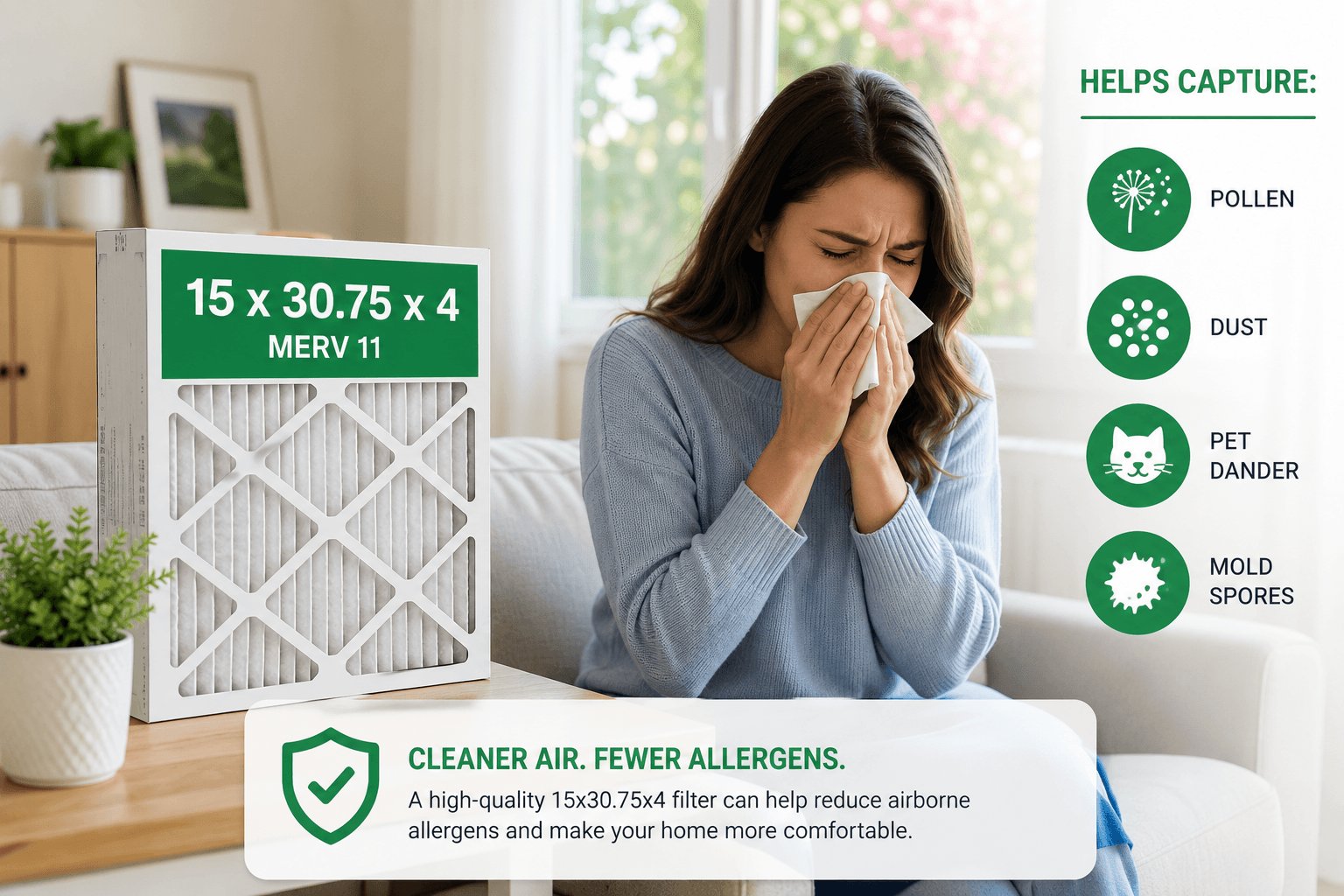
Right now, while your home looks spotless, pollen and mold spores are drifting from room to room on your own air. You can’t see them. Your sinuses can. So here’s the straight answer to the question that brought you here: yes, the right 15x30.75x4 filter can cut the pollen and allergens floating through your home during allergy season.
The size is only half the story, though. Those numbers get the filter to fit your system. The MERV rating is what actually traps allergens. Most homeowners grab the cheapest filter that fits and forget about it for six months, and that one habit is a big reason their eyes still itch every April. We’ve spent more than a decade obsessed with this exact problem, so let’s make the invisible visible and get you breathing easier.
TL;DR Quick Answers
15x30.75x4 Air Filters
A 15x30.75x4 air filter is a 4-inch-deep pleated HVAC filter with a nominal size of 15" x 30.75" x 4" and an actual size of 15" x 30.75" x 3.63". That deep profile holds far more pleated media than a 1-inch filter, so it captures more pollen, dust, pet dander, and mold while lasting longer between changes. It's an uncommon size that most stores don't stock, so ordering the exact cut-to-fit size online is the reliable way to get one.
Actual size: 15 x 30.75 x 3.63 inches. Nominal sizes round up, so measure your frame before reordering.
Best MERV for allergies: 11 for most homes, 13 for sensitive households once you confirm your system's airflow.
Replacement: about every 90 days, sooner during peak pollen.
Where to find it: rarely on local shelves; order the exact size online as a single filter, multi-pack, or subscription.
Top Takeaways
Yes, the right 15x30.75x4 filter helps with seasonal allergies. The MERV rating is what makes the real difference.
MERV 11 is the everyday allergy sweet spot. Step up to MERV 13 for sensitive households, once you confirm your system can handle it.
The 4-inch depth gives you more capture and a longer service life than a 1-inch filter.
True HEPA usually isn’t an HVAC swap, so a high-MERV pleated filter is the practical allergy choice.
Change it about every 90 days, sooner during peak pollen. A clean filter is a working filter.
Because 15x30.75x4 is uncommon, order the exact fit online and consider a multi-pack or subscription.
What the 15x30.75x4 size actually means
The numbers are simply the dimensions: 15 inches wide, 30.75 inches tall, and 4 inches deep. Filterbuy lists the true measurement as 15 x 30.75 x 3.63 inches, because “nominal” filter sizes round up. Measure your current filter or read the frame before you reorder, since a filter that’s even slightly off won’t seal properly. And that 4-inch depth earns its keep. A deep filter holds far more pleated material than a 1-inch panel, so it gives you more surface area to catch allergens and more room before it clogs. More material also means it lasts longer between changes.
How it captures seasonal allergens
A pleated filter cleans your air through mechanical filtration. Air flows through tightly packed fibers, and particles get caught on the way through. (If you want the engineering behind how mechanical air filters work, that’s worth a read.) The tighter the weave, the smaller the particle it grabs. For allergy sufferers, the targets are familiar ones: tree and grass pollen, mold spores, pet dander, and the fine dust that rides your ductwork every time the system kicks on.
Which MERV rating is best for allergies?
After more than a decade of building filters and helping millions of households, we’ll say it plainly: this is the choice that changes how you feel during pollen season.
MERV 8: A solid baseline that captures larger pollen, dust, and lint. Good for budget-minded homes without serious allergy issues.
MERV 11: Our go-to allergy pick. It catches finer pollen, pet dander, and mold spores while keeping your airflow healthy, which makes it the sweet spot for most homes with allergy sufferers or pets.
MERV 13: The strongest everyday option for sensitive households, since it captures the finest particles. Just confirm your system’s fan can handle the extra resistance. Most modern systems can, especially with a roomy 4-inch filter.
One honest word on HEPA, because the search results can steer you wrong. True HEPA filters are usually too dense for a home HVAC system to push air through, so they aren’t a drop-in replacement. For a 15x30.75x4 system, a high-MERV pleated filter gives you strong allergy performance without straining your blower. The EPA says the same thing, and you’ll find their guidance in the resources below.
How to install a 15x30.75x4 filter (about five minutes)
Switch off your HVAC system at the thermostat.
Find the filter slot, usually at the return-air grille or the air handler.
Check the airflow arrow on the old filter before you pull it out.
Slide the new filter in with that arrow pointing toward the blower or furnace.
Write the date on the frame and set a reminder to check it in 90 days, sooner during heavy pollen.
Where to buy the right 15x30.75x4 filter
Here’s the real snag with this size: 15x30.75x4 is uncommon. You won’t spot it on a shelf at Walmart, and “near me” searches usually turn up empty. We built our business around exactly that gap, so you can order the exact 15x30.75x4 size in the MERV rating you want, cut to fit. For a filter you’ll replace several times a year, a multi-pack or an auto-delivery subscription keeps cleaner air running without you having to think about it, and it lowers your cost per filter.
“After more than a decade of building filters, we’ve found that allergy sufferers get the most relief from a MERV 11 or 13 in the correct size, changed on schedule. The households that do both feel the difference within a single pollen season.”
— FilterBuy Product & Filtration Team
7 Essential Resources
Authoritative reading if you want to go deeper. Every link below was checked and confirmed live:
EPA — Guide to Air Cleaners in the Home: the federal consumer guide to furnace and HVAC filters and choosing efficiency.
EPA — What Is a MERV Rating?: how the MERV scale works and why MERV 13 gets recommended so often.
EPA — The Inside Story: A Guide to Indoor Air Quality: the foundational overview of indoor pollutants and your health.
American Lung Association — Air Cleaning: practical guidance on filters, replacement timing, and what genuinely helps.
AAFA — Pollen Allergy: the Asthma and Allergy Foundation’s primer on pollen seasons and cutting exposure.
EPA — What Is a HEPA Filter?: clarifies HEPA versus MERV and why true HEPA isn’t a typical HVAC swap.
Wikipedia — Air Filter: a plain-language overview of filter types and how filtration works.
3 Statistics Worth Knowing
Indoor air pollutant levels often run 2 to 5 times higher than outdoor levels, and sometimes far more. (EPA)
Americans spend roughly 90% of their time indoors, so indoor air is the air doing the most to your daily exposure. (EPA)
About a quarter of U.S. adults report a seasonal allergy, so you’ve got plenty of company every pollen season. (CDC)
Final Thoughts & Opinion
Our honest take, after years of obsessing over this stuff: a filter won’t cure your allergies, and anyone who tells you it will is overselling. What it will do is one of the highest-payoff, lowest-effort things you can do for your home’s air. You’re already paying to run your HVAC system. Putting the right pleated filter in the path of all that moving air means you’re cleaning your air every time the system runs, with zero extra work on your part.
If we had to give you one rule, it’s this: stop defaulting to the cheapest filter and forgetting it exists. For a home with allergy sufferers, a quality MERV 11 or 13 in the right 15x30.75x4 size, changed on schedule, is the version of “good enough” that you’ll actually feel. You’re the one protecting your household’s air. This is one of the simplest ways to do that job well.
Frequently Asked Questions
Does a 15x30.75x4 filter really help with allergies?
Yes. While your system runs, a pleated filter catches pollen, dander, and mold spores before they circulate back into your rooms. A higher MERV (11 to 13) traps more of the fine allergens that set off symptoms.
What MERV should I use for seasonal allergies?
MERV 11 is the balanced pick for most allergy households. MERV 13 captures the finest particles for sensitive family members. Confirm your HVAC system can handle the airflow first.
How often should I change it during allergy season?
Plan on every 90 days as your default, and check it monthly during heavy pollen. Pets, lots of dust, or running the fan constantly all mean you’ll want to change it sooner.
Is there a true HEPA option in 15x30.75x4?
Generally no. True HEPA restricts airflow too much for most home HVAC systems. For this size, a high-MERV pleated filter delivers strong allergy performance without straining your equipment.
Where can I buy a 15x30.75x4 filter near me or in bulk?
Because it’s an uncommon size, local shelves rarely carry it. The reliable route is to order the exact 15x30.75x4 size online, where you can pick your MERV and buy a single filter, a multi-pack, or a subscription.
Ready for Cleaner Air This Allergy Season?
Don’t let an odd filter size stand between your family and easier breathing. Order your exact 15x30.75x4 air filter in the MERV rating that fits your home. We’ll cut it to fit and ship it to your door, and you can set it on auto-delivery so a clogged filter never catches you mid-pollen-season. Pick your MERV, set a reminder, and go breathe a little easier.
Learn more about HVAC Care from one of our HVAC solutions branches…
Filterbuy HVAC Solutions - West Palm Beach FL
1655 Palm Beach Lakes Blvd., Ste 1005 West Palm Beach, FL 33401
(561) 448-3760
https://maps.app.goo.gl/VarpgNZnxuPQuW8A7