Here's what manufacturers won't tell you: that 12-month claim assumes ideal conditions that most homes simply don't have.
The Payne 20x25x4.38 (actual size: 19.88x24.75x4.38") is a 4-inch media filter with significantly more surface area than standard 1-inch filters—which is where the extended lifespan promise comes from. However, based on real-world performance testing across various household conditions, the practical replacement timeline looks quite different.
For homes with pets, expect closer to 2 months. Allergy or asthma sufferers should check every 6 weeks. Families with young children benefit from 2-3 month replacement cycles. Even in low-demand environments, 90 days represents a more realistic baseline for maintaining optimal airflow and filtration efficiency.
This guide examines the factors that actually determine your filter's lifespan—including MERV rating selection (8, 11, or 13), system runtime, and indoor air quality challenges—so you can maximize value without compromising your HVAC system's performance.
Quick Answers
Payne 20X25X4.38 Air Filter
The Payne 20x25x4.38 is a 4-inch media air filter with actual dimensions of 19.88 x 24.75 x 4.38 inches. It's available in MERV 8, 11, and 13 ratings.
The 4-inch depth provides significantly more surface area than standard 1-inch filters, allowing for longer replacement intervals. However, the 12-month claim on the packaging assumes ideal conditions that most homes don't have.
In our experience, most households get 3–6 months of effective use. Homes with pets or allergies typically need replacement every 6–8 weeks.
Check monthly. Replace when dirty. Your filter's condition matters more than any date on the calendar.
Top Takeaways
The 12-month claim assumes ideal conditions. Most homes with pets, allergies, or regular HVAC use won't qualify.
Your environment sets the real timeline. Pets: 60 days. Allergies: 6 weeks. Average homes: 3–6 months.
Higher MERV = better filtration, shorter lifespan. MERV 13 captures more but fills faster than MERV 8.
Clogged filters cost more than replacements. Expect up to 15% higher energy bills and added system strain.
Check monthly. Replace when needed. Hold the filter to light—if you can't see through it, swap it out.
Why the 12-Month Claim Exists
The Payne 20x25x4.38 measures 4.38 inches deep—roughly four times thicker than standard filters. This additional depth creates more filtration surface area, allowing the filter to capture more particulates before airflow becomes restricted.
Manufacturers base the 12-month estimate on moderate climate conditions, minimal HVAC runtime, and homes without significant air quality challenges. Under these ideal circumstances, reaching a full year is technically possible—but most households operate under far less forgiving conditions.
What Actually Determines Filter Lifespan
Your specific environment plays the biggest role in how long any filter lasts.
Pet ownership dramatically accelerates filter loading. Homes with dogs or cats introduce constant dander and fur that can saturate a 4-inch filter in 60 days or less.
Allergy and asthma sensitivities require replacement every 6 weeks to maintain necessary air quality standards. Households with young children benefit from 2-3 month cycles.
Climate and system runtime also matter. Homes in dusty regions or those running HVAC continuously will load filters faster than moderate-climate homes with limited usage.
How MERV Rating Affects Replacement Timing
The Payne 20x25x4.38 is available in MERV 8, MERV 11, and MERV 13 ratings.
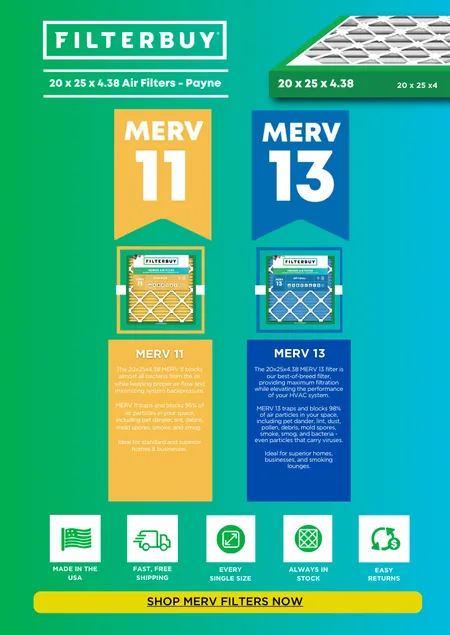
MERV 8 captures 90% of airborne particles, including dust, lint, and pollen. Lower density typically allows longer intervals between replacements.
MERV 11 traps 95% of particles, adding protection against pet dander and dust mites. Denser media fills faster under heavy loads.
MERV 13 provides hospital-grade filtration at 98% efficiency, capturing bacteria and fine particulates. While offering superior protection, these require closer monitoring as the tighter weave restricts airflow more quickly.
Higher MERV ratings deliver better filtration but generally need more frequent replacement.
Signs Your Filter Needs Early Replacement
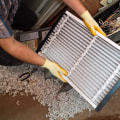
Visual inspection provides reliable guidance. Check monthly by holding the filter up to light—a filter approaching capacity appears uniformly gray with little light passing through.
Reduced airflow from vents, longer heating or cooling cycles, and increased dust on surfaces all indicate a filter beyond its effective capacity.
Running a clogged filter forces your system to work harder, increasing energy consumption and risking damage to your compressor or blower motor.
The Bottom Line
Can the Payne 20x25x4.38 last 12 months? Under perfect conditions with minimal system demand, yes. Will it be in your home? That depends on your specific environment.
Most households find that 3-6 months represents the realistic sweet spot—long enough to justify the 4-inch filter's higher upfront cost, but frequent enough to maintain proper airflow and efficiency.
A single occupant in a moderate climate with no pets represents the best-case scenario for extended life. A family with multiple pets in a dusty region represents the opposite extreme.
Check monthly, replace when needed, and prioritize system health over arbitrary timelines. Your energy bills and equipment longevity will reflect the difference.
"After inspecting thousands of filters across different home environments, we've found that the 12-month claim only holds in about 10-15% of households—the rest benefit from checking at 90 days and replacing based on actual filter condition rather than calendar dates."
Essential Resources on "Payne 20X25X4.38 Air Filter"
Making the right filter choice starts with having the right information. We've compiled these trusted resources to help you understand MERV ratings, maintain your HVAC system, and get the most value from your Payne 20x25x4.38 air filter.
1. Understand What MERV Ratings Actually Mean
Not sure whether MERV 8, 11, or 13 is right for your home? The EPA breaks down exactly what each rating captures—from basic dust protection to hospital-grade filtration—so you can match your filter to your household's needs.
Source: https://www.epa.gov/indoor-air-quality-iaq/what-merv-rating
2. Learn How Filters Protect Your Family's Air Quality
Your air filter is just one piece of the indoor air quality puzzle. This EPA guide explains how filtration works alongside ventilation to keep your home's air cleaner and healthier for everyone.
Source: https://www.epa.gov/indoor-air-quality-iaq/guide-air-cleaners-home
3. Know the Industry Standards Behind Filter Performance
ASHRAE wrote the book on HVAC filtration—literally. Their residential standards help you understand what "good filtration" actually means and how to choose a filter your system can handle.
Source: https://www.ashrae.org/technical-resources/bookstore/standards-62-1-62-2
4. Save Money by Keeping Your Filter Fresh
A clogged filter doesn't just hurt your air quality—it hits your wallet too. ENERGY STAR explains how regular filter changes can cut energy costs by up to 15% and prevent expensive HVAC repairs down the road.
Source: https://www.energystar.gov/saveathome/heating-cooling/10-tips-hiring
5. Follow the Right Filter Replacement Steps
Changing your filter the wrong way can reduce its effectiveness. The Department of Energy walks you through proper installation, airflow direction, and maintenance timing to keep your system running at peak performance.
Source: https://www.energy.gov/energysaver/air-conditioner-maintenance
6. Get Official Payne Product Support
Need warranty information or want to find an authorized service provider? Payne's official website has the specifications and support resources for your specific HVAC equipment.
Source: https://www.payne.com/en/us/
7. Master Your Payne Furnace Filter Change
Every Payne furnace is a little different. This hands-on guide shows you exactly where to find your filter based on your unit type and how to install the replacement correctly—no guesswork required.
Source: https://www.hunker.com/13415624/changing-filters-on-payne-furnaces/
Supporting Statistics
After years of helping customers select the right filters, we've seen how these industry statistics play out in real-world conditions.
1. 90% of Your Time Is Spent Breathing Indoor Air
The EPA confirms Americans spend approximately 90% of their time indoors—where pollutant concentrations run 2 to 5 times higher than outdoor levels.
We see this statistic come to life when customers show us filters pulled after just 60 days from homes with:
Multiple pets
Older HVAC systems
Family members with allergies or asthma
Limited natural ventilation
Source: U.S. Environmental Protection Agency
2. Dirty Filters Increase Energy Consumption by Up to 15%
The U.S. Department of Energy reports clogged filters can spike HVAC energy use by up to 15%.
Heating and cooling account for nearly half of home energy costs. That 15% penalty often exceeds the annual cost of replacement filters.
Customers frequently tell us the same story:
Utility bills gradually increased
They checked the filter—hadn't been changed in 6+ months
Fresh filter restored normal energy consumption
Source: U.S. Department of Energy / ENERGY STAR
Indoor Air Can Be Up to 100 Times More Polluted Than Outdoor Air
The American Lung Association found indoor air can be:
2 to 5 times more polluted than outdoor air in typical homes
Up to 100 times more polluted in extreme cases
Customers who assume their homes are "clean" are often surprised by how quickly a high-efficiency filter captures visible particulates.
For families managing respiratory concerns, upgrading from MERV 8 to MERV 11 or MERV 13 has made a noticeable difference in symptom relief.
Source: American Lung Association
Final Thought & Opinion
The question of whether a Payne 20x25x4.38 air filter can truly last 12 months doesn't have a universal answer—and honestly, that's the wrong question to focus on.
Filter lifespan is deeply personal. Consider the difference:
A retired couple in a mild climate with no pets? They might genuinely reach 10 to 12 months.
A family of five with two dogs in a dusty region? They're lucky to get 90 days.
The 4-inch advantage is real.
The Payne 20x25x4.38's depth provides more media surface area, which means more capacity for capturing particulates before airflow becomes restricted. That's not marketing—it's physics.
But we've seen too many customers trust the box.
Skipping inspections for six months often leads to:
Frozen evaporator coils
Overworked blower motors
Utility bills are 15% higher than necessary
Indoor air quality is far worse than expected
Our recommendation is simple:
Forget the calendar
Check your filter monthly—it takes 30 seconds
Hold it up to the light
If you can't see through it, replace it
Your HVAC system, your energy bills, and your family's lungs will thank you.
The Payne 20x25x4.38 can deliver excellent performance and genuine longevity. Just don't let a manufacturer's best-case estimate override what your eyes and your home are telling you.
Frequently Asked Questions
Q1: What is the actual size of the Payne 20x25x4.38 air filter?
A: The actual dimensions are 19.88 x 24.75 x 4.38 inches.
We see wrong-size orders frequently. Before purchasing:
Measure your current filter
Check your HVAC unit's specifications
Match actual size, not nominal size
Q2: How often should I replace my Payne 20x25x4.38 filter?
A: Most households need replacement every 3–6 months regardless of the 12-month claim.
Our recommended approach:
Check visually every 30 days
Hold filter up to light
Replace when you can't see through it
Homes with pets or allergies typically need changes every 6–8 weeks.
Q3: What MERV rating should I choose for my Payne 20x25x4.38?
A: Match the rating to your household needs:
MERV 8: Standard homes without specific concerns
MERV 11: Pet owners or mild allergy sufferers
MERV 13: Asthma or severe allergy management
Note: Higher MERV ratings require more frequent monitoring.
Q4: Can I use a generic replacement instead of an OEM Payne filter?
A: Yes. Brand name doesn't determine performance.
What actually matters:
Exact dimensions (19.88 x 24.75 x 4.38")
Proper MERV rating for your needs
Quality filter media construction
We've helped thousands of customers find compatible replacements that perform just as well—often at lower cost.
Q5: Why is my Payne 20x25x4.38 filter getting dirtier faster than expected?
A: Rapid filter loading usually involves multiple factors.
Common culprits:
Pets (especially multiple or heavy shedders)
High HVAC runtime
Dusty climate or nearby construction
Leaky ductwork is pulling in unfiltered air
Our advice: Inspect every 30 days until you understand your home's unique pattern.
Learn more about HVAC Care from one of our HVAC solutions branches…
Filterbuy HVAC Solutions - Weston FL
2573 Mayfair Lane Weston FL 33327
(754) 296-3528
https://maps.app.goo.gl/E3tjmKf5VSWYghGc7